This microbe turns into a ‘Hulk’ that eats its own kind
An abundance of food may set off this strange transformation
A single-celled life form named Euplotes gigatrox sometimes transforms into a supergiant that eats its regular-size siblings.
Ben T. Larson
This is a human-written story voiced by AI. Got feedback? Take our survey . (See our AI policy here .)
A newly discovered microbe is like a mini version of the Hulk.
This single-celled protist looks a bit like an insect. It normally grazes on bacteria and other microbes. But sometimes, a small number of this predator — named E. gigatrox — balloon to more than twice their regular size.
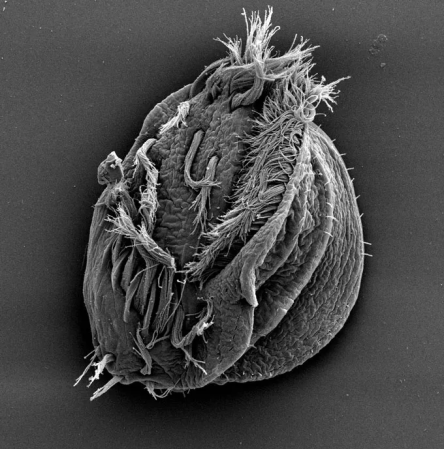
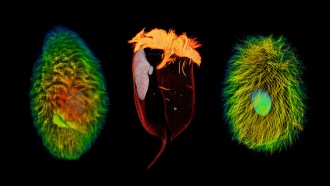
Euplotes gigatrox may look like an insect, but it’s a type of single-celled protist called a ciliate. It has lots of hairlike cilia surrounding its mouth parts (large oval depression, top). This microscope image shows the underside of the cell’s supergiant form.
As they enlarge, these “supergiant” cells turn into cannibals, gobbling up their smaller siblings. What triggers the change isn’t all that clear. But it tends to happen when there is plenty of food.
Researchers shared their new findings May 14. The work appeared in the Proceedings of the National Academy of Sciences.
Morphing into a supergiant happens in steps, says Ben Larson. A cell biologist, he works at Rensselaer Polytechnic Institute in Troy, N.Y. He discovered the Hulked-out microbes in gunk scraped from a filter at an aquarium in Curaçao. That’s a Dutch territory in the Caribbean Sea.
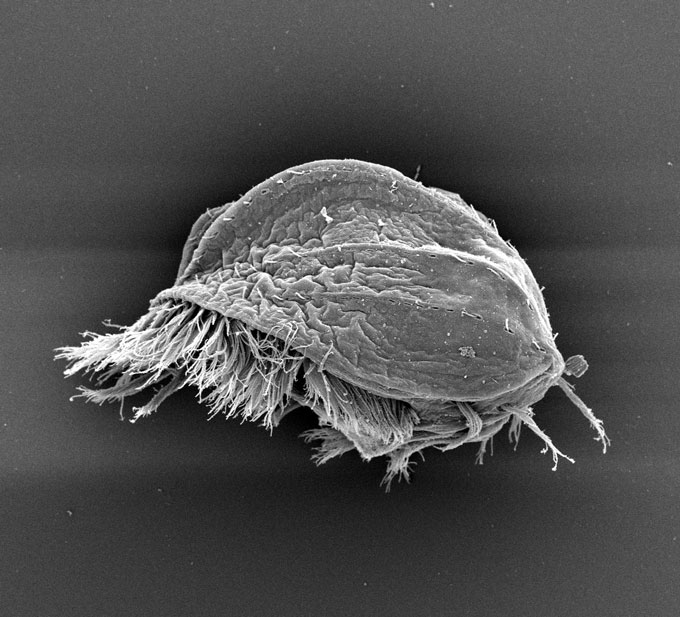
Euplotes gigatrox has two different forms: regular size and supergiant. This is a side view of the supergiant. It eats its smaller siblings by running over them and jamming them into its mouth. That mouth lurks behind the fringe of hairlike cilia.
In the first stage, “a cell gets a big mouth,” Larson says. Then, “they start running around like crazy.” At that point, they still aren’t great cannibals. But watch out! Once a would-be Hulk catches one of its siblings or cousins in its enlarged mouth, its whole body plan changes. These cells “grow up to be these just enormous cannibalistic supergiants,” Larson says.
Like Bruce Banner and the Hulk, giants and regular-size cells act differently. Regular size cells walk and swim. The big ones can only walk in circles.
Giants can return to their former size by lopsided splitting. Normal-size E. gigatrox divide just once per day. Shrinking Hulks, in contrast, can produce nine normal-size offspring in the first day. Over five days, they can generate up to 16 offspring.
Each time a giant cell divides, it shrinks somewhat. Eventually it returns to normal size and behavior.
Up to 42 percent of the species’ genes are involved in shifting from regular size to giant and back again. Learning how these protists do this may offer clues about how simple life forms develop complex behaviors. It might even point to how many-celled life first evolved.
Do you have a science question? We can help!
Submit your question here, and we might answer it an upcoming issue of Science News Explores